
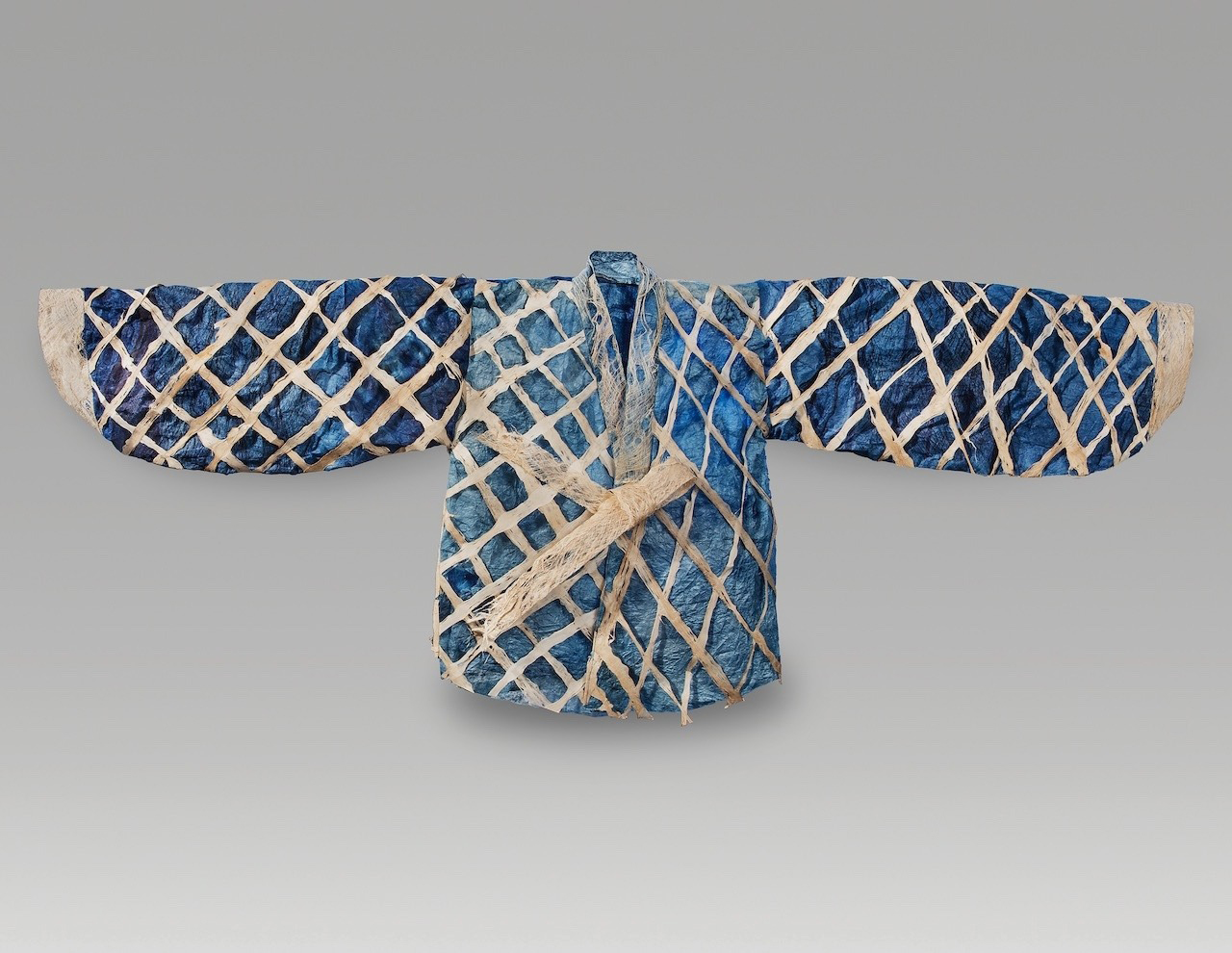
The Â鶹´«Ã½ Museum announces “Aimee Lee: Every Last Scrap,â€� a solo exhibition featuring internationally recognized artist and scholar Aimee Lee. Opening Aug. 14, the exhibition features garments created entirely by hand from hanji (han = Korean; ji = paper), traditional paper made from the bark of mulberry trees.
Through labor-intensive papermaking, natural dyes and the careful reuse of every scrap of material, Lee transforms traditional hanji into sculptural garments that connect centuries-old Korean craftsmanship with contemporary artistic practice.
“Aimee Lee invites visitors into a world of brilliantly colored, exquisitely crafted garments made entirely of handmade paper,â€� said Sarah Spinner, Ph.D., J.D., director of the Â鶹´«Ã½ Museum. “These are not clothes to be worn, but works of art that encourage us to think differently about clothing, craft and the materials from which they are made.â€�
Born in New York to immigrant parents, Lee traveled to Korea on a Fulbright grant to study the disappearing art of hanji. Working with leading teachers and masters of the craft, she learned to make, fuse, texture, twine, weave and dye hanji before returning to the United States committed to preserving the tradition and continuing its legacy through her own studio practice, teaching and scholarship.
Lee transforms raw paper mulberry bark into handmade paper through a labor-intensive process before printing and dyeing the paper with natural materials including indigo, onion skins and cochineal. She has also developed a lace-like material from mulberry bark that serves both as a structural material for her garments and as a matrix for printmaking.
Many of the works in the exhibition take the form of hanbok (han = Korean; bok = clothing), the general term for traditional Korean clothing. Rather than discarding the off-cuts created during construction, Lee saves every scrap of material and incorporates it into future works. The resulting patchwork designs reflect her commitment to sustainably stewarding the materials she cultivates and crafts.
Curated by Sara Hume, Ph.D., curator and professor at the Â鶹´«Ã½ Museum, the exhibition highlights Lee's ongoing exploration of paper as both material and medium, connecting traditional Korean papermaking practices with contemporary artistic expression.
"Aimee's work demonstrates that paper is far more than a surface for drawing or writing," Hume said. "While she creates work in the form of clothing, she is not bound by the dimensions of the human form. Her works are in a range of sizes that allow her to make use of resulting remnants."
Lee said, “I grew up in a family that was just barely removed from the ravages of war, where frugality was a virtue, and even a toothpaste box could be rendered forever useful. Papermaking was a revelation to me, because I could use any number of plants and rags to transform cellulose into paper, and paper into art. Hanji became a way to connect to my heritage, and to other far-flung members of the Korean diaspora. Once I learned that the virtue of sewing in Korea was to use every last scrap, I understood my innate desire to save and stitch together an entire world from years of papermaking, dyeing, printing and bark manipulation. Each bit holds a story, and together the ensuing garments build new narratives for our ever-evolving world.�
An opening reception for “Aimee Lee: Every Last Scrapâ€� will be held from 5-7 p.m. on Thursday, Aug. 27 at the Â鶹´«Ã½ Museum. The evening will include a welcome reception from 5-5:45 p.m., curator remarks and artist introduction from 5:45-6 p.m., and exhibition viewing with an opportunity to meet the artist from 6-7 p.m.
The event is free and open to the public. Space is limited, and advance registration is required by Aug. 7.
“Aimee Lee: Every Last Scrapâ€� will be on view at the Â鶹´«Ã½ Museum from Aug. 14, 2026, through May 24, 2027. The exhibition is generously sponsored by Ken Robinson and Pamela Jacobson, with operating support from the Ohio Arts Council.
About Aimee Lee
Aimee Lee is a papermaking artist, scholar and culture bearer who advocates for Korean papermaking practices (B.A., Oberlin College; M.F.A., Columbia College Chicago). Her initial Fulbright research led her to establish the first hanji studio in North America and write the award-winning book “Hanji Unfurled.â€� A two-time Fulbright recipient, Lee has exhibited internationally at institutions including the Cleveland Museum of Art, Fuller Craft Museum, Allen Memorial Art Museum, Museum of Nebraska Art and the Korean Cultural Centers in Washington, D.C., New York and Abu Dhabi. Her work is held by the Â鶹´«Ã½ Museum, Cleveland Museum of Art, Bainbridge Island Museum of Art, and the libraries of the Metropolitan Museum of Art, Museum of Modern Art, Brooklyn Museum, Harvard University, Yale University, Stanford University, UCLA, Oxford University and the Rijksmuseum. She continues to teach papermaking internationally and serves as an Ohio Arts Council Heritage Fellow.
About the Â鶹´«Ã½ Museum
The Â鶹´«Ã½ Museum holds one of the world's most important collections of fashion, textiles and decorative arts, from the Byzantine era to the present. With nearly 30,000 objects and seven gallery spaces, the museum serves students, scholars and the broader public through exhibitions, research and object-based learning. In 2025, the museum was reaccredited by the American Alliance of Museums, the highest national recognition a museum can receive. For more information, visit www.kent.edu/museum or follow us on and .
Image: Aimee Lee, Rift (2024). Ink, indigo, hanji, bark, thread. 57 x 25.5� x 3�
###